 也是一只自由泳的小鸟
@
也是一只自由泳的小鸟
@
‘Spirit’ comes from the Latin word ‘to breathe’. What we breathe is air, which is certainly matter, however thin. Despite usage to the contrary, there is no necessary implication in the word ‘spiritual’ that we are talking of anything other than matter (including the matter of which the brain is made), or anything outside the realm of science. On occasion, I will feel free to use the word. Science is not only compatible with spirituality; it is a profound source of spirituality.
今天学到的!Spirit, soul, psyche 什么什么的全都来源于拉丁语 spīritus 和希腊语 ψυχή,也就是“呼吸”的意思
Every time a scientific paper presents a bit of data, it’s accompanied by an error bar - a quiet but insistent reminder that no knowledge is complete or perfect.
[…]
Imagine a society in which every speech in the Congressional Record, every television commercial, every sermon had an accompanying error bar or its equivalent.
好棒的 idea!
When you’re in love, you want to tell the world. This book is a personal statement, reflecting my lifelong love affair with science.
原来还可以这样表白!
If we teach only the findings and products of science - no matter how useful and even inspiring they may be - without communicating its critical method, how can the average person possibly distinguish science from pseudoscience? Both then are presented as unsupported assertion.
[…]
It is enormously easier to present in an appealing way the wisdom distilled from centuries of patient and collective interrogation of Nature than to detail the messy distillation apparatus. The method of science, as stodgy and grumpy as it may seem, is far more important than the findings of science.
Perhaps the sharpest distinction between science and pseudo-science is that science has a far keener appreciation of human imperfections and fallibility than does pseudoscience (or ‘inerrant’ revelation). If we resolutely refuse to acknowledge where we are liable to fall into error, then we can confidently expect that error - even serious error, profound mistakes - will be our companion forever.
我刚打开有声书拿起毛衣,想形容自己像过年一样快乐,然后意识到真的在过年!我为啥这么开心?
我已经喝醉了而且超级开心!之前有邀过朋友但今年是一个人过年!非常开心!
这就开新书
今年打算看一点理工科的教材 我觉得我小说看太多了,涉猎不广泛,而且很多小说其实挺没意思的,完全不如教科书吸引人
#读书
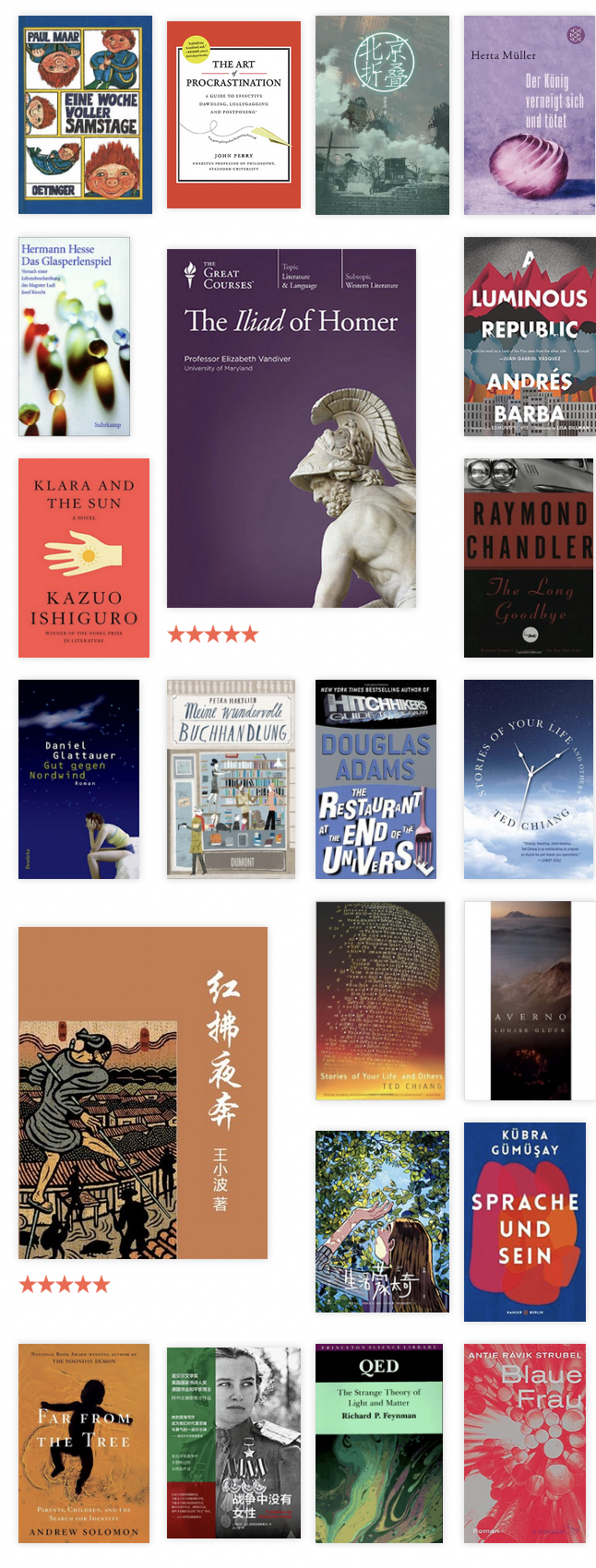
2021 年看过的书就这样了吧,45 本 11704 页,依旧还有很多书想看。。
今年的选书不是很成功,很多书都是看到一些人猛推才去看的,结果看了一点儿也不喜欢,而且总是抱着一种“可能好看的在后面”的想法硬是看完了,结果最后果然还是不喜欢。。2022 年希望自己能够早点弃掉不喜欢的书,多看自己想看的。
接下来是一些私人猛推,tag 点进去是我的摘抄,要再点进原文才能看到串:
- #DerKönigVerneigtSichUndTötet 我觉得 Herta Müller 真的很好,她的语言和视角非常独特。她出生于罗马尼亚一个说德语的村庄,来到德国之后说的也并不是德国人的德语。对于我这种身在国外而且对语言感兴趣的人,她的很多对语言的思考和观察让我觉得非常亲切。Der König verneigt sich und tötet 应该算是散文集,里面提到了一些她其它书的写作思路和背景,#Herztier (心兽)是我 2020 年看的,那本是小说,我觉得也非常不错,政治压迫敏感的人应该有共鸣。2022 年打算继续看她的书。
- #МоскваПетушки 又名 Die Reise nach Petuschki/ Moscow to the End of the Line/ 从莫斯科到佩图什基。是一本题材和写作手法都非常独到的书。德语版的封面上写着 Die hochprozentigste Sauftour der Weltliteratur, 概括得非常准确,整本书写的就是主人公在从莫斯科到佩图什基的火车上不断喝酒,讲一些非常深刻幽默的胡话。很神奇的是书里主角最后的命运也预测了作者在现实生活里的命运,可能是作者早有预感。
- #TheLongGoodbye 钱德勒写的,可能是我推的这几本里剧情性最强的,cp 很好嗑,主角非常闷骚,虽然是第一人称视角但几乎没有心理描写,所有的情绪都在主角的行动以及和他人的对话中,所以细节非常丰满,故事也很精彩。是侦探小说,但我认为并不算推理小说,因为没有怎么给线索,都是主角自己有了一个猜测然后就去验证。
- #红拂夜奔 是今年看过的最满意的中文小说!主人公是一个数学家,在写一本古代的小说,一边讲他的小说一边穿插着他证数学定理的过程,两种叙事融合在一起,在奇妙的地方交叉。王小波真的很棒,看问题很透彻,而且他说的很多话在今天也完全适用,感觉中国其实没有怎么变。就是某些关于女性的性描写还是让我不太舒服。。
- Eine Woche voller Samstage 这应该算一个搞笑奖了吧,因为其实剩下的看过的书都没有那──么好了。这是本很轻松幽默的经典童书,看起来挺快的。忘记摘抄了,但真的非常有意思,逻辑很胡扯但又很自洽。
此外还想推荐一下几本对心理健康很有帮助的书:#HowEmotionsAreMade,讲情绪的来源, #TheWillpowerInstinct,讲提升自制力但,#LostConnections,讲抑郁症的。
今年读过的一些烂书:#Averno,#DasGlasperlenspiel (非常主观的评价)
哇,看完了!费曼这本 QED: The Strange Theory of Light and Matter 出乎意料地简单好懂诶,也就集中读了两天吧!前两个 lectures 都是非常基础非常有逻辑衔接得也很好的内容,如果是工科生的话应该差不多在课本里都学过了,第三个 lecture 的后半部分和第四个 lecture 就突然神奇起来,更像科普了,读起来好像就是“我没法给你解释清楚但事情就是我讲的这个样子,虽然看起来一团糟,但 Nature 一直都是一团糟,只不过我们还在一步步寻找规律而已”,反正读完之后产生了强烈地去读一下正经教科书的兴趣
So when some fool physicist gives a lecture at UCLA in 1983 and says, “This is the way it works, and look how wonderfully similar the theories are,” it’s not because Nature is really similar; it’s because the physicists have only been able to think of the same damn thing, over and over again.
我又猜中了这个 fool 就是他自己
In books it says that science is simple: you make up a theory and compare it to experiment; if the theory doesn’t work, you throw it away and make a new theory. Here we have a definite theory and hundreds of experiments, but we can’t compare them!
It was expected that only protons and neutrons would come out. But when the energies became sufficiently large, new particles came out. First there were pions, then lambdas, and sigmas, and rhos, and they ran out of the alphabet.
为何我联想到新冠。。。或者 run out of the alphabet 是常事吧
(向您安利中文(认真